Your morning deserves more than an ordinary scoop. Discover the hydrolyzed collagen, skin-focused actives and everyday ease behind Essentials. Five reasons to make it your daily ritual.
Brand-authored guide · Ingredient research linked throughout
01 · The morning coffee upgrade
Keep the morning. Give your scoop more purpose.
The first coffee. Breakfast at the counter. Ten quiet minutes before your inbox. Use a familiar moment as the reminder for your daily serving, rather than building another routine from scratch.
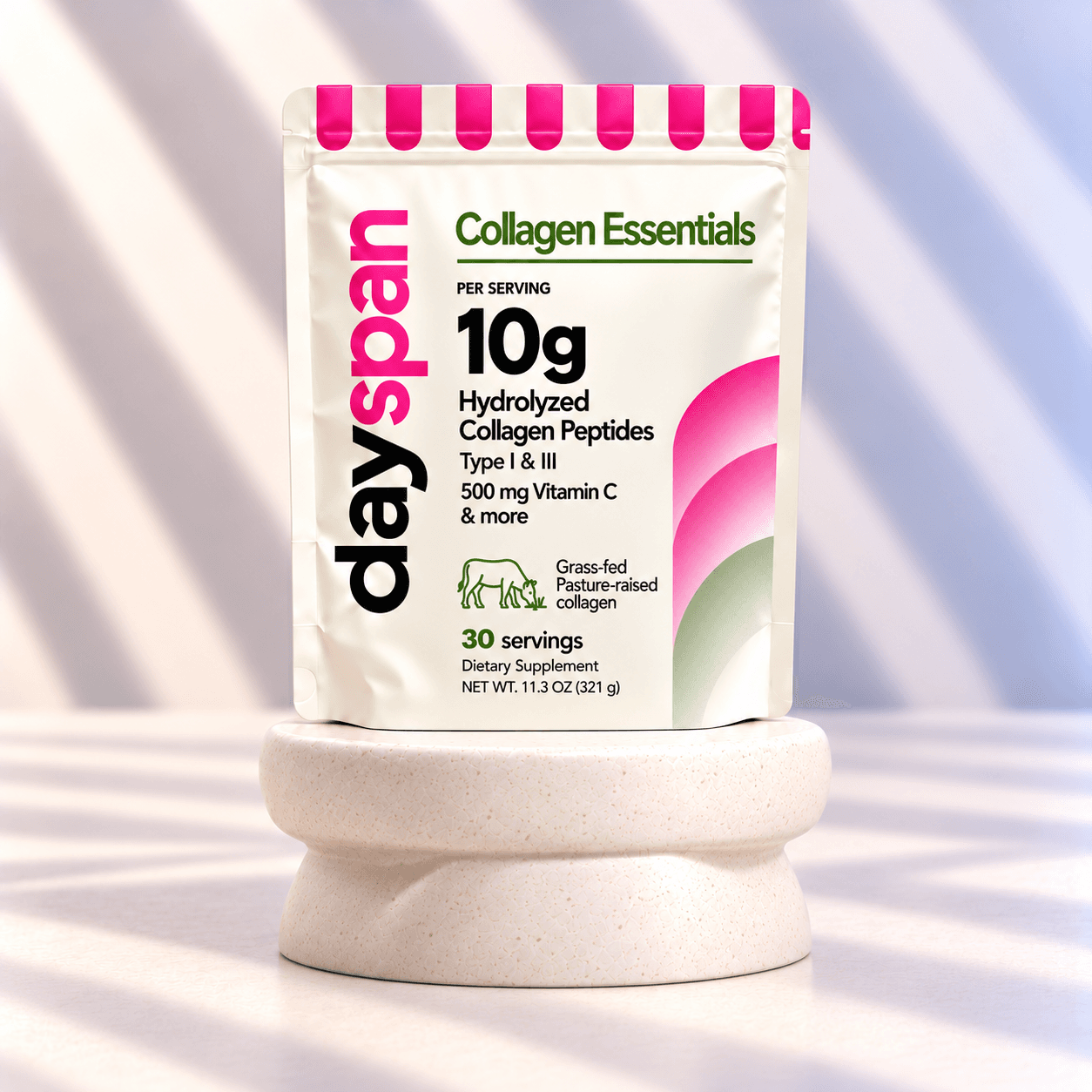
Essentials brings 10 g of hydrolyzed bovine collagen together with HA, vitamin C, lutein and zeaxanthin. Five disclosed active amounts. One 30-serving bag. Less to assemble bottle by bottle.
Essentials tastes great and dissolves well, with no added flavoring. A full collagen serving and four supporting actives, made for a routine you can keep. Follow the product directions when preparing your serving.
Your skin changes. Your routine can grow with you.
Collagen is part of skin’s underlying structure. Research comparing younger and older human skin has documented reduced collagen production with age. It is a reason to understand the biology behind the beauty aisle, rather than chase another overnight promise.††
Start with the daily basics: nutrition, sun protection and a routine you can keep. Essentials adds a full collagen serving and 500 mg vitamin C to support normal collagen formation.†
The amount, structure and production of collagen can change across adult life. Your age alone does not predict a supplement result.
Qualitative illustration · no universal annual decline rate or product outcome is implied.
03 · The purity and solubility questions
Make the label your first test.
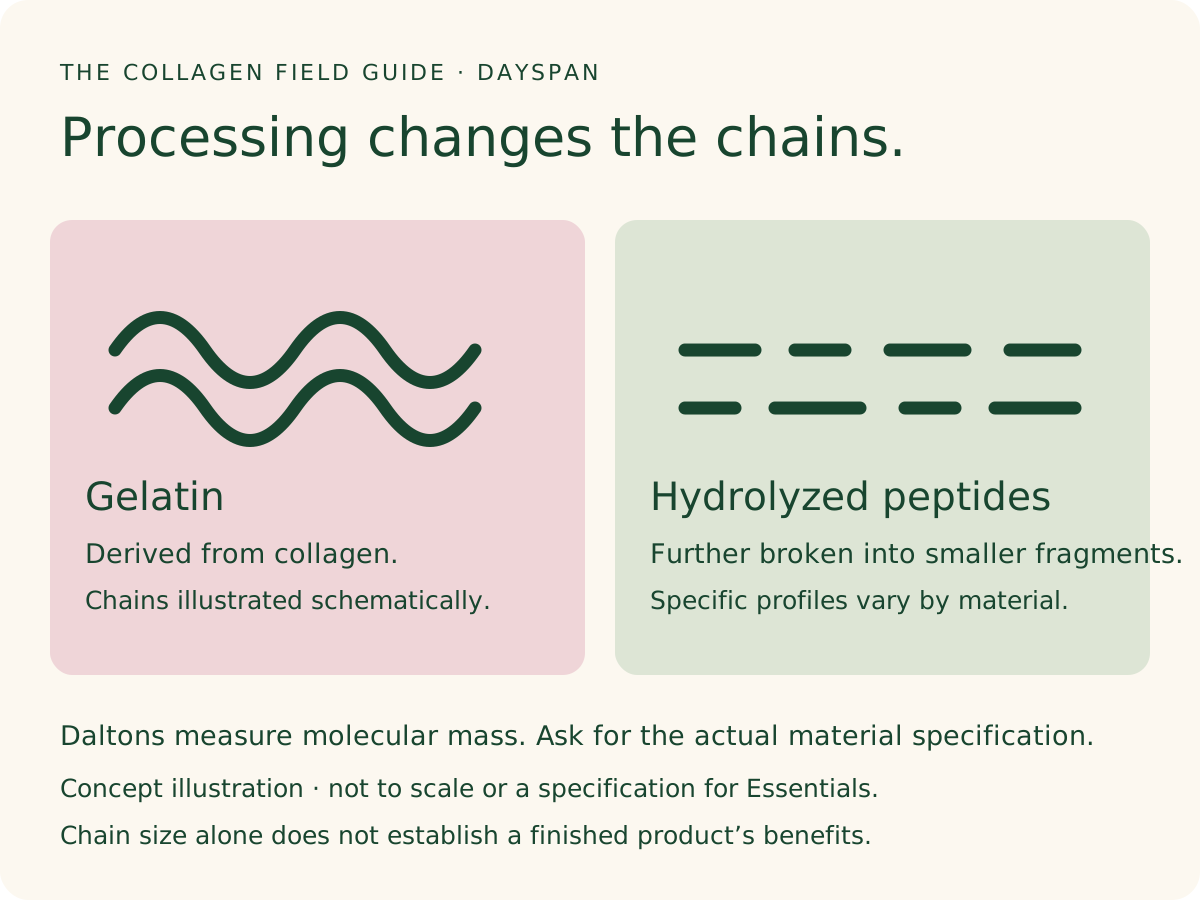
“Hydrolyzed” means collagen has been broken into smaller peptide fragments. In a human absorption study, researchers identified food-derived peptides in blood after participants consumed particular gelatin hydrolysates.††
That makes the ingredient worth understanding. It also makes source, dose and documentation better shopping questions than a string of impressive badges.
Where does the collagen come from?Essentials specifies hydrolyzed bovine collagen peptides of Types I and III origin.
What is in a full serving?10 g collagen, 200 mg active HA, 10 mg lutein, 2 mg total zeaxanthin isomers and 500 mg actual vitamin C. No fillers.
What evidence supports the finished material?Ask for sourcing, batch testing and preparation details. Final supplier documentation and finished-blend sensory work remain part of production qualification.
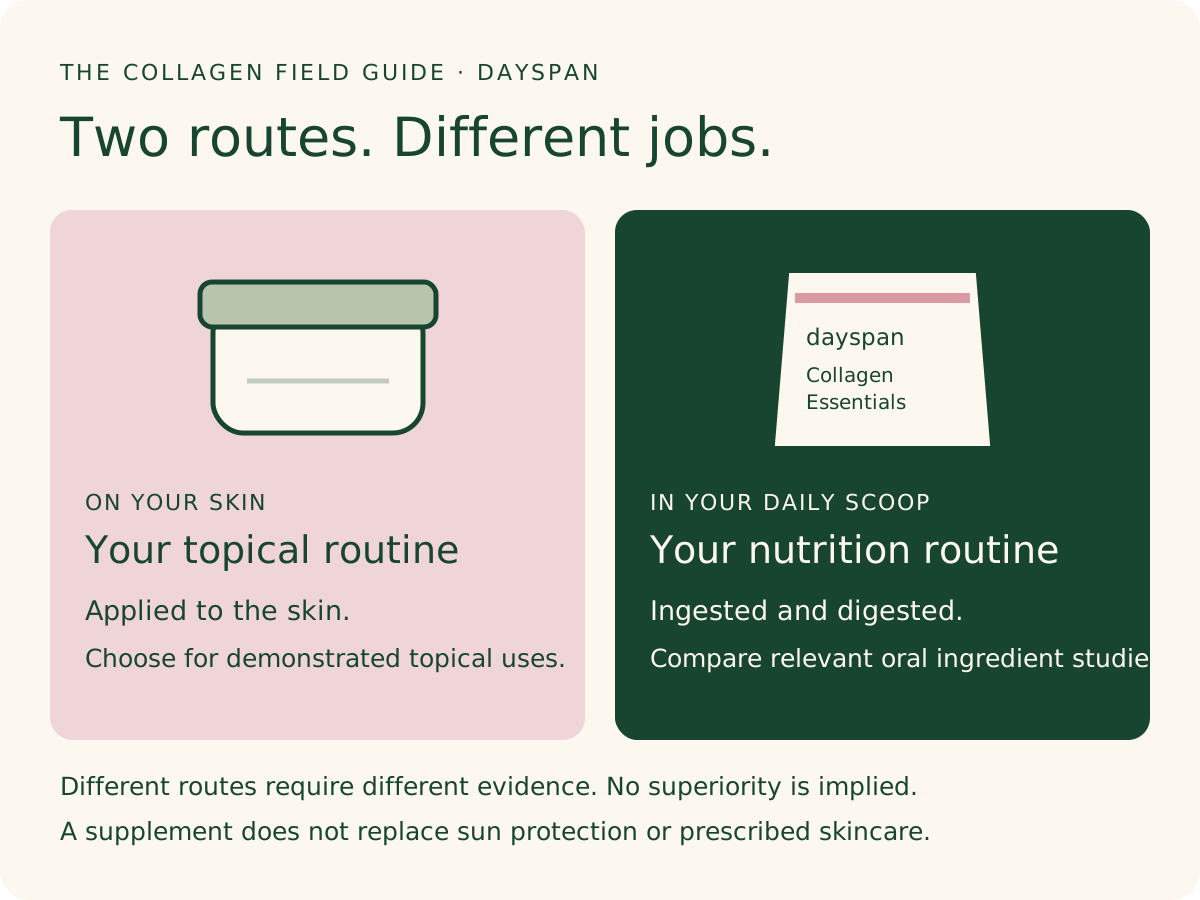
A collagen ingredient in a skincare jar and collagen peptides you ingest are different approaches. A moisturizer works as topical care. An oral supplement enters the digestive process. One is not proof of what the other will do.
Keep the skincare you love. When you compare a daily supplement, look at its actual ingredients and the human research behind them. Essentials brings collagen, HA and carotenoids together with vitamin C’s established role in normal collagen formation.†
Human collagen skin research includes positive findings and contrary results in higher-quality and non-industry-funded subgroups. Ingredient studies do not establish that Essentials outperforms a cream.††
Different routes. Different evidence. A supplement does not replace sun protection or prescribed skincare. Open comparison at full size ↗
05 · Joint mobility and active living
A collagen conversation beyond the mirror.
The walk you look forward to. Time in the garden. The weekend court. Collagen research extends beyond skin into questions about activity-related joint comfort.
A 24-week randomized study tested 10 g daily of a specific collagen hydrolysate in athletes. Of 147 enrolled participants, 97 were included in the statistical evaluation; several joint-pain measures improved versus placebo.††
It is ingredient research to explore, not a promise that this formula treats joint pain or rebuilds cartilage. Essentials’ vitamin C supports normal collagen formation as part of your daily nutrient intake.†
Every Essentials bag contains 30 daily servings of the same five-active formula. Compare current options, ingredient amounts and purchase terms before choosing.
Planning for 90 or 180 servings is a choice about convenience and value, not a guaranteed results timeline.
†† Ingredient studies examine specific forms, doses and groups of people. Findings have limits and do not establish the effects of the finished Essentials formula. Explore the original research and its limitations below.
Ingredient research & sources
Explore human research on collagen, skin aging, absorption and activity-related joint comfort, plus vitamin C’s established nutrient roles. Study populations, materials, doses and results differ.
Oral hyaluronic acid: Michelotti et al., 2021 — a 60-person trial of a specific 200 mg full-spectrum preparation reported improved skin measures versus placebo. This is not a verified 200 mg pure-HA equivalent.
Lutein and zeaxanthin: Palombo et al., 2007 — a small oral/topical study examined skin measures using an oral regimen of 10 mg lutein and 0.6 mg zeaxanthin in oil softgels.
Skin aging: Varani et al., 2006 — human tissue and fibroblast comparisons investigated reduced collagen synthesis with age; not a supplement trial or universal annual decline rate.
Peptide absorption: Iwai et al., 2005 — food-derived peptides were identified in blood after particular gelatin hydrolysates; an absorption finding does not establish a clinical benefit for another formula.
Activity-related joint comfort: Clark et al., 2008 — 24 weeks with a specific 10 g collagen hydrolysate; 147 athletes enrolled and 97 statistically evaluated. Several pain measures improved, with study limitations and further research needed.